

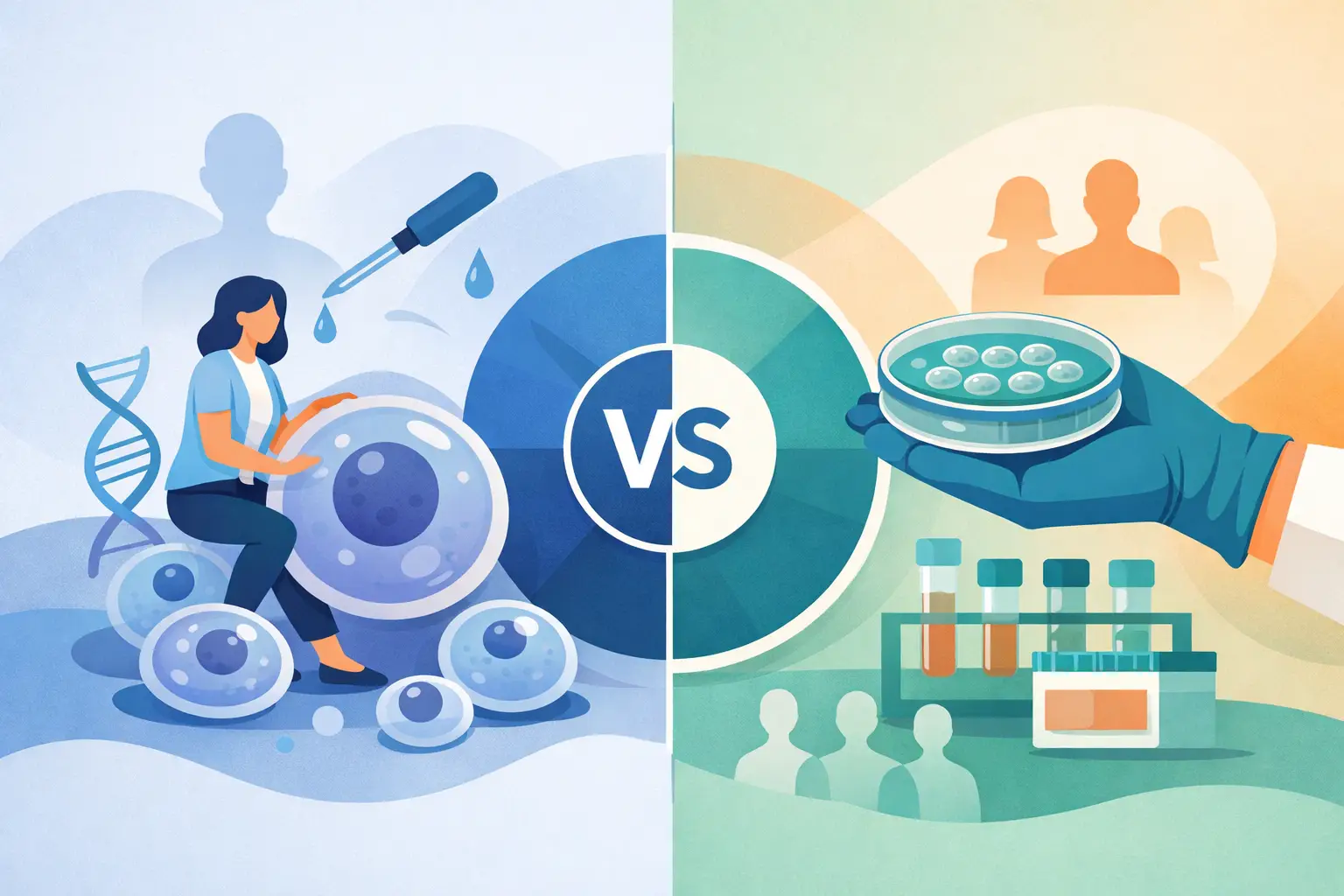
Autologous Versus Donor Cells: What Fits?
A cell therapy conversation often begins with a personal question: can the body’s own healing resources be used, or is a donor-derived cell product the more practical path? In autologous versus donor cells, the answer is not simply about which option sounds more natural. It is about cell source, treatment goals, timing, medical history, manufacturing standards, and the level of evidence for a specific condition.
For patients pursuing regenerative care for joint degeneration, recovery, inflammatory concerns, neurologic conditions, or healthy aging, understanding this distinction can make consultations more productive. Both approaches are being studied across regenerative medicine, but they are biologically and clinically different. A responsible treatment plan should reflect those differences rather than treating all cellular therapies as interchangeable.
Autologous Versus Donor Cells: The Core Difference
Autologous cells come from the person receiving treatment. Depending on the procedure and clinical protocol, the source may be bone marrow, adipose tissue, peripheral blood, or another patient-derived tissue. Bone marrow concentrate, for example, is an autologous biologic procedure that contains a mix of cells, signaling factors, and platelets obtained from the patient’s own marrow.
Donor cells, also called allogeneic cells, come from another person. They may be sourced from carefully screened donated tissues, including perinatal tissues in certain research and clinical settings, then processed, tested, stored, and prepared for administration under a defined protocol.
The distinction changes the entire treatment pathway. Autologous care starts with a collection procedure, followed by preparation and administration. Donor-derived products can sometimes be available without collecting tissue from the recipient, but their use carries a different set of scientific, regulatory, and immune-related questions.
Why Cell Source Can Shape the Treatment Experience
The appeal of autologous treatment is clear. The biologic material originates from the patient, which may reduce certain compatibility concerns associated with cells from another individual. For patients who prioritize a highly personalized, body-derived approach, this can be a meaningful advantage.
Autologous procedures also have practical limits. Cell populations and regenerative signaling capacity can vary with age, health status, medications, metabolic conditions, smoking history, and the tissue source selected. A 35-year-old competitive athlete and a 72-year-old patient managing multiple chronic conditions may not yield the same biologic profile from an autologous collection.
Donor-derived cells offer a different potential advantage: consistency and immediate availability. A properly screened and standardized donor-derived product may be prepared in advance, avoiding the need for a collection procedure on the day of treatment. This can be relevant for patients who are not ideal candidates for harvesting or who require a more streamlined treatment schedule.
However, “donor” does not automatically mean superior, and “your own cells” does not automatically mean better. The appropriate choice depends on what is being administered, how it is processed, where it is delivered, and whether credible clinical evidence supports that approach for the patient’s diagnosis.
Immune Considerations Are More Nuanced Than They Sound
Autologous material is generally recognized by the body as self. That does not mean every autologous procedure is free from risk. Collection procedures, injections, infusions, contamination, and inappropriate processing all require rigorous clinical safeguards. It does mean that immune incompatibility is typically a less central concern than it may be with donor-derived material.
Donor cells are often discussed for their immunomodulatory properties, particularly in the context of mesenchymal stromal cells. Yet immune behavior varies by cell type, preparation method, dose, route of administration, and recipient health. Donor screening and quality control are essential, but they do not erase the need for careful patient selection, adverse-event monitoring, and transparent risk discussion.
For any treatment involving donor-derived cells, patients should ask how the donor material was screened, how the product was processed and stored, what testing was performed, and what oversight governs its use. Clear answers are part of medically responsible regenerative care.
The Trade-Off Between Personalization and Convenience
Autologous procedures are inherently individualized because the starting material comes from the patient. This may suit someone seeking a treatment pathway that incorporates their own platelets, marrow-derived concentrate, or tissue-derived cells alongside rehabilitation, nutrition, and physician-directed wellness support.
The trade-off is that collection can add time and complexity. Bone marrow aspiration, for instance, is a medical procedure that should be performed by experienced clinicians using appropriate sterile technique and pain-management protocols. Processing also needs to be timely and controlled so the resulting biologic preparation is used as intended.
Donor-derived approaches may reduce the procedural burden for the patient. They can also make standardized dosing or repeat scheduling more feasible in some settings. Still, convenience should never be the deciding factor on its own. A treatment should be selected because it is medically appropriate, ethically sourced, legally compliant, and supported by a rational clinical objective.
What the Evidence Can – and Cannot – Tell You
Regenerative medicine is an active field of research, not a single established treatment category. Evidence differs sharply among conditions and between products that may be marketed using similar language. Research findings for one cell type, processing method, or route of administration cannot automatically be applied to another.
For musculoskeletal care, autologous platelet-rich plasma and bone marrow concentrate are commonly discussed as adjunctive biologic options. Their potential roles, patient outcomes, and appropriate indications remain dependent on the joint or tissue involved, the severity of disease, and the treatment protocol. For systemic, neurologic, autoimmune, cardiovascular, or age-management applications, the evidence base may be more limited, emerging, or variable.
Patients deserve direct language about this. Cellular treatments may be offered as investigational, adjunctive, or personalized options, but they should not be presented as guaranteed cures for chronic disease. A premium clinical experience should include careful screening, realistic goals, informed consent, and coordination with the patient’s existing medical team when appropriate.
Questions to Bring to a Regenerative Medicine Consultation
A meaningful consultation should move beyond broad promises of regeneration. It should examine whether an autologous or donor-based approach fits the patient’s health status and goals. Consider asking these questions:
- What exact cell or biologic product is being proposed, and what tissue does it come from?
- Is the material autologous or donor-derived, and why is that source appropriate for my case?
- What evidence supports this protocol for my condition, symptoms, or functional goal?
- What are the expected benefits, realistic limitations, risks, and alternatives?
- How are cells collected, processed, tested, stored, and administered?
- What physician supervision, follow-up, and adverse-event monitoring are included?
These questions help distinguish a considered medical program from a vague sales pitch. The answers should be specific, comprehensible, and tailored to the patient rather than based on a one-size-fits-all package.
When Autologous Cells May Be Considered
An autologous approach may be explored when a patient has sufficient overall health for collection and the proposed procedure has a clear rationale. It can be particularly appealing when the therapeutic strategy centers on concentrated patient-derived biologic material, such as PRP or bone marrow concentrate, and when the goal is localized support for a musculoskeletal concern.
It may also appeal to patients who value using their own tissue and prefer to avoid donor sourcing. Yet age alone should not determine eligibility. An experienced physician should consider blood work, medication use, comorbidities, tissue quality, procedural tolerance, and the patient’s broader care plan.
When Donor-Derived Cells May Be Considered
Donor-derived products may enter the discussion when collection is not practical, when a standardized product is being evaluated, or when a physician believes a specific donor-based protocol is better aligned with the treatment objective. The quality of the clinical framework matters greatly here: sourcing, traceability, sterility, storage, administration, and post-treatment observation are not background details. They are central to patient safety.
US patients should also understand that regulatory status matters. Not every cellular product or regenerative procedure is approved by the Food and Drug Administration for every claimed use. Before proceeding, ask whether a proposed therapy is FDA-approved for the intended indication, offered under an appropriate investigational pathway, or provided as a procedure with a distinct regulatory framework.
At CellStemClinic, the most valuable starting point is not choosing a label such as autologous or donor-derived. It is a physician-led assessment that identifies what your body needs, what the science can reasonably support, and whether a regenerative program belongs within your wider health strategy.
The right next step is to seek clarity, not urgency. A well-designed plan should leave you feeling informed about the source of the cells, grounded in realistic expectations, and confident that your long-term wellbeing remains the priority.

