

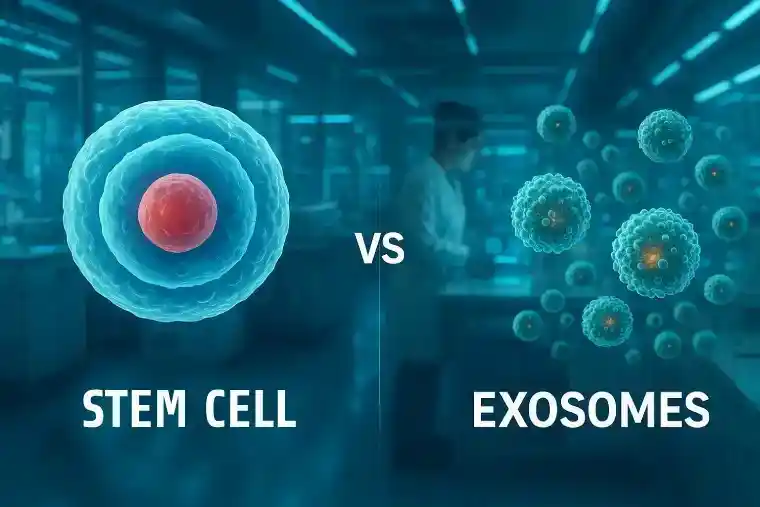
Stem Cells Versus Exosomes: Key Differences
A patient with painful knees, persistent fatigue, or a neurologic condition may hear two terms repeatedly during a regenerative medicine consultation: stem cells versus exosomes. They are related, but they are not interchangeable. One involves living cells with broad biological activity; the other involves tiny cell-derived particles that carry signals between cells. Understanding that distinction is essential before choosing a treatment pathway.
For patients seeking a more restorative approach to chronic disease, injury recovery, or healthy aging, the question is rarely which option is simply “better.” The more useful question is which approach, if any, fits the diagnosis, treatment goals, medical history, and current evidence. A physician-led plan should make that decision carefully rather than treating regenerative medicine as a one-size-fits-all solution.
Stem Cells Versus Exosomes: The Core Difference
Stem cells are living cells with the capacity to respond to their environment, release biologically active substances, and, depending on their type and clinical use, support repair processes within damaged or inflamed tissue. In regenerative medicine, mesenchymal stem cells, often called MSCs, are of particular interest because of their signaling and immunomodulatory properties. They may influence inflammation, tissue support, vascular signaling, and the behavior of neighboring cells.
Exosomes are not cells. They are microscopic extracellular vesicles released by cells, including stem cells. Think of them as biological messengers. They can contain proteins, lipids, and genetic material that help cells communicate with one another. Researchers are studying whether these signals can support aspects of healing, reduce inflammatory signaling, or influence tissue repair without introducing living cells.
That difference has practical consequences. A stem cell therapy involves viable cells that remain biologically active after administration. An exosome-based product is cell-free and depends on the quality, concentration, purity, and biological activity of the vesicles it contains. Both approaches are scientifically compelling, yet each presents different questions around sourcing, processing, dosing, safety, and regulation.
Why Stem Cells May Offer a Broader Biological Response
Stem cell-based therapies are often considered when a patient needs a more comprehensive regenerative strategy. MSCs and other progenitor cells do not work as simple replacement parts. Their potential value lies largely in the signals they release and the way they may interact with the body’s own repair environment.
For example, in musculoskeletal care, a clinician may consider cellular therapies alongside rehabilitation, targeted injections, platelet-rich plasma, or bone marrow concentrate. The intention is not to promise that damaged cartilage, tendons, or joints will be fully restored. Rather, the goal may be to support a healthier healing environment, reduce persistent inflammatory activity, improve comfort, and help a patient progress more effectively with movement and conditioning.
In broader wellness and age-management programs, stem cell-based protocols may be discussed for patients focused on vitality, recovery, immune resilience, or functional decline. These programs require especially thoughtful expectations. Energy, mobility, sleep, and quality of life are meaningful outcomes, but they can also be influenced by nutrition, hormone status, sleep quality, medication use, stress, exercise capacity, and underlying disease.
Because stem cells are living biologic materials, their handling matters greatly. Cell source, donor screening, laboratory practices, storage, viability, route of administration, and physician oversight can affect both the treatment experience and the rationale for use. A premium regenerative program should be built around clinical assessment, not a generic infusion offered without diagnostic context.
Where Exosomes May Fit
Exosomes have generated attention because they may capture some of the signaling activity associated with stem cells in a cell-free format. In theory, this could offer advantages in manufacturing, storage, and administration. Researchers are investigating exosomes in areas such as wound healing, inflammatory conditions, neurologic disease, cardiovascular health, hair restoration, and skin rejuvenation.
The appeal is understandable. If cellular signals can be delivered without living cells, treatment may become more standardized in some settings. Exosomes may also be explored as an adjunct to procedures intended to support tissue quality or recovery.
However, the science is still developing. Not all products labeled as exosomes are alike, and product quality can vary substantially. There is no universal standard for the exact contents, dose, or clinical use of exosome products across every condition. A vial may contain vesicles from different sources, in different concentrations, with different processing methods. Those details are not technical footnotes – they are central to whether a product has a credible clinical rationale.
Patients should also understand that exosome therapy is not automatically a lower-risk or more advanced substitute for stem cell treatment simply because it is cell-free. Any biologic intervention should be evaluated for source material, sterility, testing, route of administration, potential immune effects, and appropriateness for the individual patient.
Evidence, Regulation, and Honest Expectations
Regenerative medicine moves quickly, but responsible care must move at the pace of evidence and patient safety. Some stem cell-based treatments and exosome applications remain investigational or are used in clinical settings where evidence is still emerging. Regulations vary by country, and a treatment that is marketed internationally may not have the same regulatory status in the United States.
This does not mean every emerging therapy lacks value. It means claims should be proportionate to the evidence. Patients deserve clear answers about what is known, what remains uncertain, what alternatives exist, and what outcomes are realistic for their condition.
Be cautious of providers who guarantee a cure, claim that one biologic can treat every disease, or discourage conventional medical care. Regenerative therapies may complement established treatment, but they should not replace necessary specialist evaluation, medications, surgery, rehabilitation, or emergency care. For progressive neurologic disease, autoimmune conditions, cardiovascular concerns, or complex chronic illness, coordination with the patient’s existing medical team is particularly important.
Choosing Between a Cellular and Cell-Free Approach
The right conversation begins with the patient, not the product. Someone with an isolated tendon injury has different needs from someone managing osteoarthritis, post-viral fatigue, neuropathy, or age-related decline in function. The treatment plan should account for diagnosis, imaging or laboratory findings where appropriate, severity, previous treatments, overall health, and personal goals.
A clinician may favor a stem cell-based approach when the therapeutic strategy calls for living cellular activity and a more individualized regenerative protocol. Exosomes may be considered where a cell-free signaling approach is clinically appropriate, available through a reputable pathway, and supported by a transparent discussion of limitations. In some programs, platelet-rich plasma or bone marrow concentrate may also be relevant because these therapies use the patient’s own biologic components and can be paired with rehabilitation or targeted procedural care.
Route of delivery also matters. An intravenous infusion, a localized joint injection, a spinal or neurologic protocol, and an aesthetic application are not equivalent interventions. They involve different goals, risks, and standards of assessment. Patients should ask why a particular route is being recommended and what outcome it is intended to support.
Questions Worth Asking Before Treatment
A high-quality consultation should leave a patient more informed, not merely more persuaded. Ask what cell type or exosome source is being used, how the material is screened and processed, and why it is appropriate for your diagnosis. Ask what evidence supports the proposed use, what side effects or complications are possible, and how outcomes will be measured over time.
It is also reasonable to ask about the full program. Does it include medical follow-up, rehabilitation guidance, laboratory monitoring, nutrition support, or coordination with your primary physician? Regeneration is rarely a single-event process. The strongest plans recognize that cellular therapies, if used, work within the larger context of the patient’s biology and lifestyle.
For many patients, the most valuable next step is not choosing stem cells or exosomes immediately. It is arranging a thorough medical review, bringing prior records and imaging, and asking for a treatment recommendation that is specific to your body, your goals, and the level of uncertainty you are willing to accept.

