

Can PRP Treat Tennis Elbow? What to Expect
A persistent ache on the outside of the elbow can make everyday movements unexpectedly difficult. Lifting a coffee cup, turning a door handle, typing, or returning a backhand may all provoke pain. So, can PRP treat tennis elbow? For appropriately selected patients, platelet-rich plasma may support the tendon-healing process and offer a biologic option when symptoms have not settled with rest, rehabilitation, and conventional care.
Tennis elbow is common in athletes, but most people who develop it do not play tennis. It is often linked to repeated gripping, lifting, computer work, manual work, racket sports, or a sudden increase in activity. A regenerative approach such as PRP is designed to work with the body’s own healing signals rather than simply masking discomfort.
What tennis elbow actually involves
Tennis elbow, medically called lateral epicondylitis or lateral epicondylalgia, affects the tendons that attach the forearm muscles to the bony prominence on the outer side of the elbow. These tendons help extend the wrist and stabilize the hand during gripping.
Despite the “-itis” label, long-standing tennis elbow is not always driven by active inflammation. In many chronic cases, the tendon has developed disorganized collagen fibers, small areas of degeneration, and a reduced capacity to tolerate load. This distinction matters. Anti-inflammatory treatments can sometimes ease pain in the short term, yet they may not address the underlying tendon quality that contributes to recurring symptoms.
A careful assessment should also rule out other causes of outer elbow pain, including nerve irritation, arthritis, neck-related pain, or a more substantial tendon tear. The best treatment plan starts with an accurate diagnosis, not a one-size-fits-all injection.
Can PRP treat tennis elbow by supporting tendon repair?
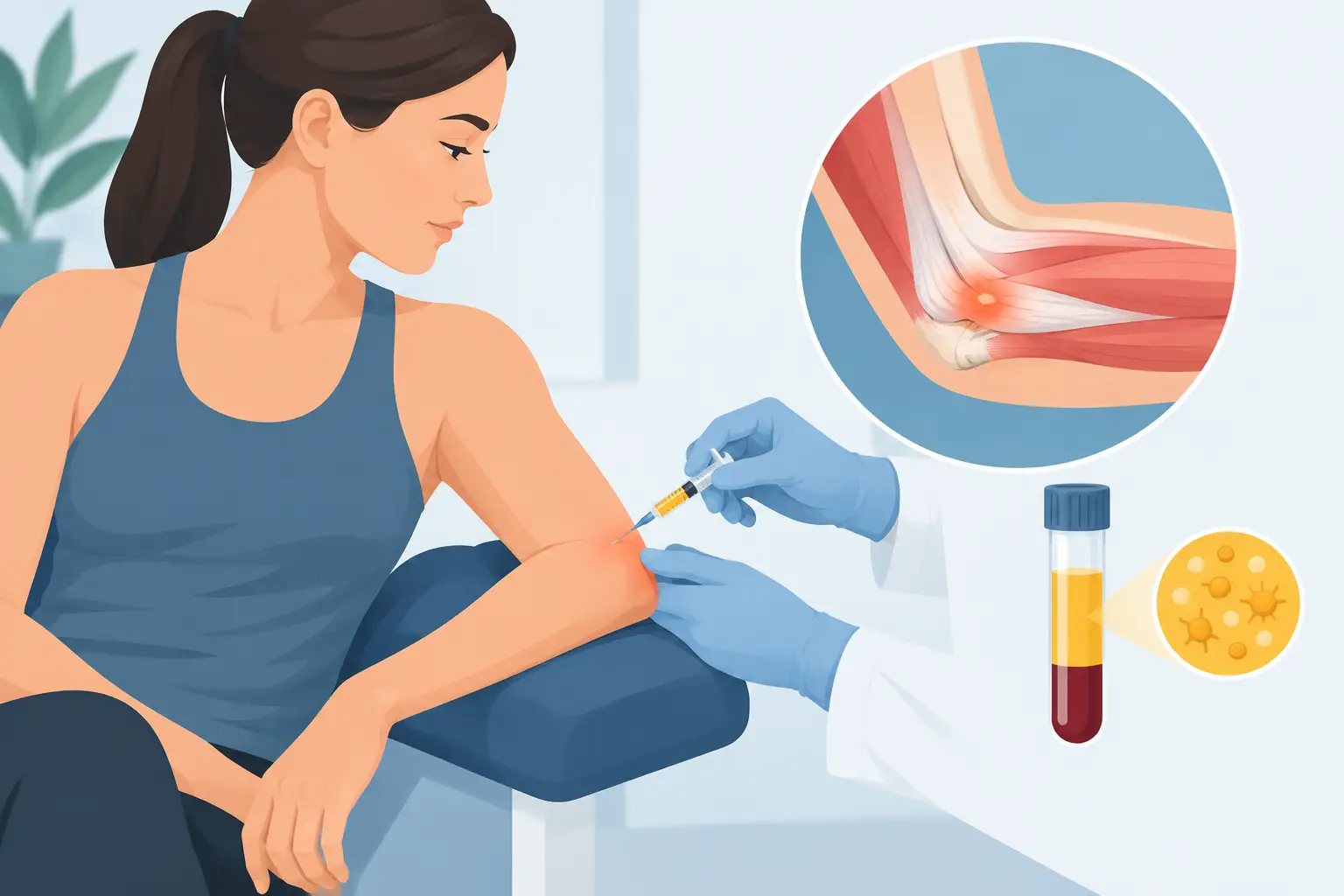
PRP is prepared from a small sample of your own blood. After processing, the platelet-rich portion is isolated and injected into the affected tendon region, often with ultrasound guidance. Platelets contain signaling proteins and growth factors involved in tissue repair, cell communication, and blood-vessel response.
The goal is not to create an instant pain-relieving effect. Instead, PRP aims to stimulate a controlled healing response in tendon tissue that has failed to recover fully. This can make it particularly relevant for people with chronic symptoms, especially when a structured exercise program and activity modification have not produced meaningful improvement.
Research into PRP for tennis elbow has produced encouraging but mixed results. Some studies show better medium- to long-term improvement in pain and function compared with certain injections or conservative treatment alone, while others find limited differences. Variations in PRP preparation, platelet concentration, injection technique, patient selection, and rehabilitation protocols make direct comparisons difficult.
That does not mean PRP lacks value. It means expectations should be individualized. PRP may be a reasonable consideration for a patient with confirmed chronic tendon degeneration, but it is not a guaranteed cure and should not be presented as a substitute for diagnosis, rehabilitation, or sound load management.
Who may be a good candidate for PRP?
PRP is often considered when elbow pain has continued for several months despite appropriate nonsurgical care. Candidates may include active adults who want to return to sport, professionals whose work requires repetitive hand use, and patients seeking to reduce their reliance on repeated corticosteroid injections or long-term medication.
A consultation should explore the duration and pattern of pain, previous treatments, occupational demands, medical history, and functional goals. Imaging, such as diagnostic ultrasound or MRI, may be appropriate when the diagnosis is uncertain or a tendon tear is suspected.
PRP may be less suitable when pain is caused primarily by a nerve problem, joint disease, infection, or another condition unrelated to tendon degeneration. People with certain bleeding disorders, active infection, significant anemia, or medications that affect clotting may require additional assessment. A clinician should review all supplements and medications before treatment, including anti-inflammatory drugs that may be paused around the procedure when medically appropriate.
What happens during PRP treatment for tennis elbow?
The appointment begins with a blood draw, usually from the arm. The blood is processed in a centrifuge to concentrate platelets within the plasma. The clinician then identifies the treatment area and cleans the skin. Ultrasound guidance can help place the injection accurately within or around the involved tendon tissue.
The procedure is typically completed in one visit. Local anesthetic may be used around the skin or surrounding tissues, depending on the clinical protocol, although injecting anesthetic directly into the tendon is generally approached with caution. Patients may feel pressure or temporary discomfort during treatment.
Some treatment plans involve a single injection, while others recommend more than one based on the severity of the condition, response to the first procedure, and imaging findings. More treatment is not automatically better. The number of injections should reflect a clear clinical rationale and progress assessment.
Recovery is part of the treatment, not an afterthought
The elbow may feel more sore, stiff, or tender for several days after PRP. This post-procedure response can occur as the body reacts to the injection. It is usually managed with relative rest, ice if advised, and clinician-approved pain relief. Because anti-inflammatory medications may affect the intended healing response, patients are often asked to avoid them for a period before and after treatment unless another physician has prescribed them for a necessary condition.
Most patients are not expected to return immediately to heavy lifting, racket sports, or repetitive manual tasks. Early protection is followed by a progressive rehabilitation plan. This typically includes mobility work, gradual strengthening of the wrist extensors and forearm, and carefully increased tendon loading.
Improvement is usually measured in weeks and months, not days. Some patients notice an early change, while others improve more gradually as they rebuild strength and confidence in the elbow. A realistic recovery timeline depends on how long symptoms have been present, tendon health, work demands, rehabilitation adherence, and whether aggravating activities can be modified.
PRP compared with common tennis elbow treatments
Conservative care remains the starting point for many people. It may include adjusting painful activities, using a brace selectively, targeted physical therapy, and a progressive loading program. These measures can be highly effective, especially when treatment begins early and the person can modify the repetitive stress that caused the problem.
Corticosteroid injections may offer faster short-term pain reduction for some patients, but repeated steroid use around a degenerative tendon deserves caution. It may not support tendon restoration and can be associated with poorer longer-term outcomes in some cases. PRP is different in intent: it is designed as a biologic regenerative adjunct rather than a rapid anti-inflammatory intervention.
Shockwave therapy, needling approaches, and surgery can also be considered in selected cases. Surgery is generally reserved for persistent, function-limiting symptoms that have not responded to well-delivered nonsurgical treatment. The right option is influenced by the diagnosis, symptom duration, structural tendon changes, and the patient’s goals.
Benefits, limitations, and safety considerations
Because PRP is autologous, meaning it comes from your own blood, the risk of allergic reaction is low. Still, no injection is risk-free. Possible side effects include temporary pain, bruising, swelling, bleeding, infection, nerve irritation, and lack of improvement. Ultrasound-guided delivery and medically supervised protocols can support precision and safety, but they do not remove all risk.
The potential advantage of PRP is its ability to introduce concentrated biologic signaling into an area of tendon dysfunction. Its limitation is that the healing response cannot be guaranteed or precisely predicted. Chronic tendon problems are influenced by mechanics, tissue quality, overall health, sleep, metabolic factors, and the demands placed on the arm after treatment.
For this reason, premium regenerative care should be thoughtful rather than rushed. A high-quality plan connects biologic treatment with diagnosis, rehabilitation, follow-up, and a realistic pathway back to work, exercise, or sport.
Questions to ask before choosing PRP
Before proceeding, ask whether your diagnosis has been confirmed, whether imaging is needed, and what PRP preparation and guidance technique will be used. You should also understand the expected recovery schedule, the rehabilitation plan, the total anticipated cost, and what alternatives remain appropriate for your case.
At CellStemClinic, a consultation can help determine whether PRP is an appropriate component of a personalized regenerative plan for persistent tendon pain. The aim is not simply to quiet an elbow temporarily, but to support stronger function and more confident movement over time.
If tennis elbow has begun shaping how you work, train, or live, seek an evaluation that looks beyond the symptom alone. The most useful next step is a plan that respects both the biology of tendon healing and the life you want to return to.

