

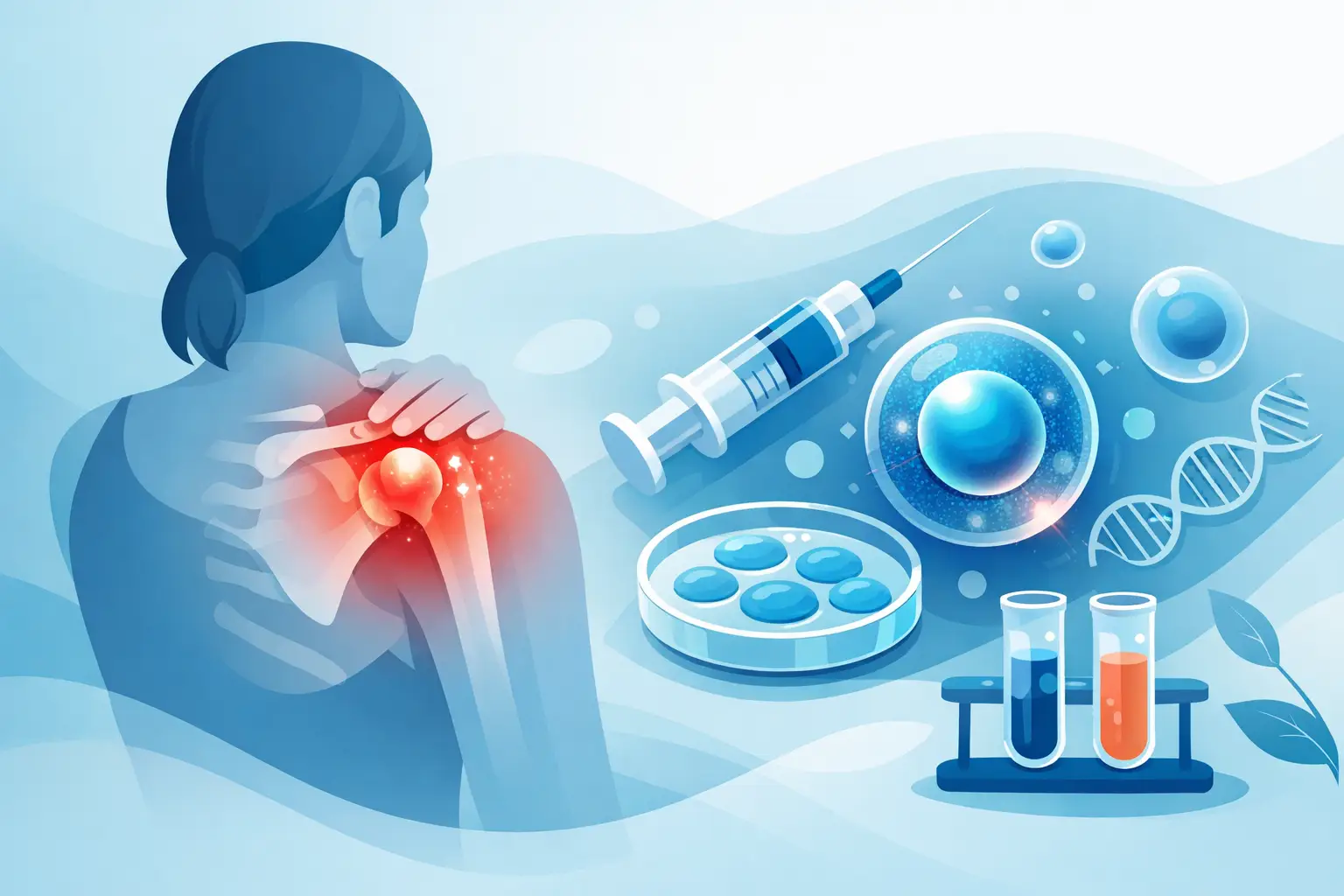
Regenerative Medicine for Frozen Shoulder
A shoulder that once moved freely can become surprisingly restrictive. Reaching into a cupboard, fastening a seat belt, sleeping on one side, or putting on a coat may trigger sharp pain or feel impossible. For people who have not found enough relief with rest, medication, or standard physical therapy, regenerative medicine for frozen shoulder is an increasingly discussed option.
Frozen shoulder, also called adhesive capsulitis, is not simply a sore shoulder. It involves inflammation and tightening of the shoulder capsule, the connective tissue that surrounds the joint. A regenerative approach aims to support the body’s biological repair environment while addressing pain, inflammation, and restricted movement. It should be considered thoughtfully, as part of a physician-led plan rather than a replacement for an accurate diagnosis and rehabilitation.
Why Frozen Shoulder Can Be So Difficult to Treat
Frozen shoulder commonly develops in stages. The first is often called the freezing stage, when pain escalates and range of motion begins to decline. During the frozen stage, pain may become less intense but stiffness can be profound. In the thawing stage, movement may gradually return, sometimes over many months.
Some people recover with conservative care, but the timeline is unpredictable. Symptoms can persist for one to three years, and occasionally longer. The condition is more common in adults between 40 and 60, particularly in people with diabetes, thyroid conditions, recent shoulder immobility, or a history of surgery or injury.
Standard care may include anti-inflammatory medication, guided physical therapy, corticosteroid injection, hydrodilatation, or, in more persistent cases, manipulation under anesthesia or arthroscopic capsular release. These options can be appropriate and effective. Yet they also have trade-offs: medication may not address the underlying inflammatory environment, overly aggressive therapy can aggravate pain, and invasive procedures carry their own recovery considerations.
That is where biologic and regenerative options may enter the conversation.
What Regenerative Medicine for Frozen Shoulder May Involve
Regenerative medicine is a broad term. In musculoskeletal care, it may include autologous platelet-rich plasma (PRP), bone marrow concentrate (BMC), and, in selected settings, cell-based therapies involving mesenchymal stromal cells or related progenitor cell preparations.
The goal is not to promise an instant cure or to force a stiff joint to move before it is ready. Rather, a carefully designed program may seek to influence the inflammatory signaling around the shoulder, support tissue health, reduce pain that limits rehabilitation, and create better conditions for progressive mobility work.
Platelet-Rich Plasma
PRP is made from a patient’s own blood. After processing, the platelet-rich portion is concentrated and prepared for injection. Platelets contain signaling molecules involved in healing and tissue response. In shoulder care, PRP may be considered when tendon irritation, bursitis, or degenerative changes are contributing to symptoms alongside capsular stiffness.
For frozen shoulder itself, the evidence base is still developing. Some clinical studies suggest PRP may improve pain and range of motion, especially when paired with appropriate exercise therapy. Results can vary based on the stage of frozen shoulder, injection technique, the PRP formulation, and whether other shoulder conditions are present.
Bone Marrow Concentrate
BMC is typically obtained from the patient’s own bone marrow, often from the pelvic bone, and processed into a concentrated preparation. It contains a mixture of cells, growth factors, and signaling components that may support the body’s reparative processes.
In a regenerative treatment pathway, BMC may be discussed for complex musculoskeletal presentations where tissue degeneration, chronic inflammation, or poor recovery capacity is suspected. It is more involved than PRP and is not automatically the best choice for every person with a frozen shoulder. A detailed clinical assessment is essential before considering it.
Cell-Based Therapies
Mesenchymal stromal cell-based treatments are of significant scientific interest because these cells can influence inflammatory signaling and communicate with surrounding tissues through paracrine factors. However, the clinical evidence specifically for adhesive capsulitis remains limited, and regulatory status varies by product and location.
Patients should be cautious of any provider who guarantees that stem cells will reverse frozen shoulder or eliminate the need for rehabilitation. Responsible regenerative care involves transparent discussion of what is known, what remains investigational, anticipated costs, potential risks, and realistic measures of progress.
The Most Valuable Step Is a Precise Diagnosis
Not every stiff, painful shoulder is frozen shoulder. Rotator cuff tears, arthritis, calcific tendinitis, labral injury, cervical nerve irritation, and inflammatory disease can produce overlapping symptoms. Treating the wrong condition with any injection, conventional or regenerative, is unlikely to deliver the result a patient wants.
A physician-led evaluation should review the pattern of pain, passive and active range of motion, prior injury, metabolic health, medications, and imaging when indicated. In true frozen shoulder, both active and passive motion are restricted, especially external rotation. That clinical distinction helps guide whether biologic treatment is sensible or whether another intervention deserves priority.
For patients with diabetes, glucose management also matters. Elevated blood sugar is associated with a higher risk of adhesive capsulitis and may affect inflammation and healing. A shoulder program is stronger when it recognizes these whole-body factors rather than treating the joint in isolation.
Regenerative Treatment Works Best Alongside Guided Movement
Biologic procedures are not a substitute for rehabilitation. Once pain is manageable, the shoulder needs carefully progressed mobility and strengthening work to regain function. The right approach is usually gentle, consistent, and tailored to the stage of the condition.
In the painful early stage, a clinician may focus on calming symptoms and protecting sleep while avoiding forceful stretching. As irritability decreases, targeted range-of-motion work can become more productive. Later, strength and shoulder-blade control help restore confidence in everyday movement.
A premium, personalized care plan may combine diagnostic assessment, image-guided biologic procedures where appropriate, pain and inflammation management, and coordinated rehabilitation. This integrated model can be particularly valuable for active adults, travelers, executives, and patients who want structured support rather than fragmented appointments.
Who May Be a Candidate?
A person may consider regenerative options when shoulder symptoms have persisted despite a reasonable trial of conservative care, when medication is poorly tolerated, or when the goal is to explore less invasive biologic support before surgical procedures. Candidates should have a clear diagnosis, realistic expectations, and the ability to participate in the rehabilitation process afterward.
There are also situations where regenerative treatment may need to wait or may not be suitable. Active infection, uncontrolled medical conditions, certain blood disorders, anticoagulant use, pregnancy, and unexplained severe pain require individualized medical review. Previous surgery, significant arthritis, or a full-thickness tendon tear can change both the diagnosis and the treatment strategy.
At CellStemClinic, a regenerative consultation should begin with the patient’s history, function, imaging, and treatment goals – not with a predetermined procedure. The best treatment is the one that matches the biology of the condition, the stage of recovery, and the person behind the shoulder.
Questions Worth Asking Before You Proceed
Before choosing a clinic or procedure, ask what diagnosis is being treated, why that specific biologic option is recommended, and how the injection will be guided. Ask about the source and processing of any cellular product, the clinician’s experience, expected recovery after the procedure, and the rehabilitation plan.
It is also reasonable to ask how success will be measured. Pain scores matter, but so do sleep, external rotation, ability to dress independently, return to work, and confidence using the arm. A responsible provider will discuss the possibility of limited benefit and explain what the next step would be if improvement is incomplete.
Frozen shoulder can make daily life feel smaller, one guarded movement at a time. The right medical conversation can make it feel more manageable again: clarify the diagnosis, protect the joint from unnecessary aggravation, and choose a treatment path that gives your body the best possible opportunity to restore comfortable movement.

