

How Does PRP Treatment Work?
When pain lingers, recovery stalls, or the signs of tissue wear start affecting daily life, many patients ask the same question: how does PRP treatment work? The short answer is that PRP, or platelet-rich plasma, uses a concentrated portion of your own blood to support the body’s natural repair response. The more useful answer is that PRP is not magic, and it is not one-size-fits-all. It is a biologic treatment designed to deliver a higher concentration of platelets and growth factors to an area that may benefit from targeted regenerative support.
For patients looking beyond symptom masking, that distinction matters. PRP is often considered when conventional care has plateaued, when surgery feels premature, or when someone wants a treatment approach grounded in the body’s own healing mechanisms.
How does PRP treatment work in the body?
Platelets are best known for helping blood clot, but that is only part of their role. They also contain signaling proteins and growth factors that help coordinate tissue repair. When an injury occurs, platelets arrive early and release biochemical signals that help recruit other cells, support new blood vessel formation, and influence inflammation.
PRP treatment works by concentrating those platelets from a sample of your own blood and placing them into a specific area of concern. That area might be a tendon, ligament, joint, scalp, or skin, depending on the clinical goal. By increasing the local delivery of platelets and their signaling molecules, PRP aims to create a more favorable environment for repair and recovery.
This is why PRP is often described as a regenerative or restorative treatment. It does not replace damaged tissue overnight. Instead, it is designed to stimulate and support a biological process that can unfold over weeks or months.
What happens during a PRP procedure?
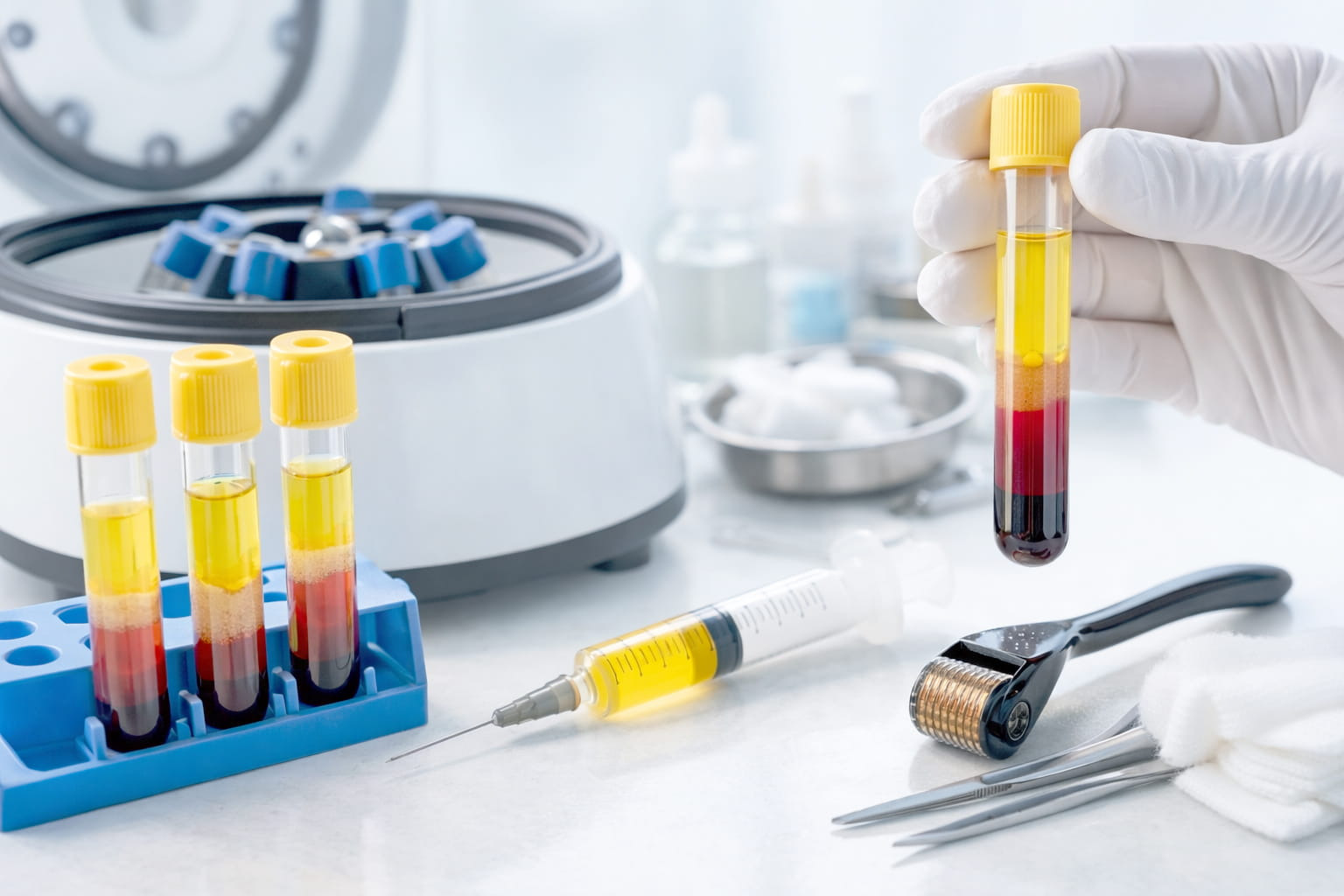
The process is relatively straightforward, though precision matters. A clinician first draws a small amount of blood, much like a routine blood test. That blood is then placed in a centrifuge, which spins it at high speed to separate its components.
After separation, the platelet-rich portion is collected. This concentrated plasma contains a higher platelet level than standard circulating blood. Depending on the treatment protocol, the PRP may then be injected into the target area using palpation or imaging guidance.
The quality of the procedure does not depend only on spinning blood and injecting it back. Good PRP treatment depends on careful patient selection, the right preparation method, and accurate placement. A shoulder tendon, an arthritic knee, and thinning hair each involve different tissue biology, so the treatment plan should match the condition rather than rely on a generic formula.
Why concentration and technique matter
Not all PRP is identical. This is one of the most important points patients often miss.
Different preparation systems can produce different platelet concentrations, different white blood cell content, and different final volumes. Some protocols aim for leukocyte-rich PRP, while others use leukocyte-poor PRP depending on the tissue being treated and the clinical objective. These differences can influence how inflammatory the injection feels and how the tissue responds.
Technique matters just as much. If PRP is being used for a tendon issue, placing it near the area of degeneration is more useful than injecting broadly into a painful region. If it is used in aesthetic medicine, the depth and pattern of delivery affect the result. In other words, PRP is a medically progressive tool, but it works best when the clinician understands both the biology and the anatomy.
What conditions may PRP help with?
PRP is used across several areas of medicine because platelets are involved in repair throughout the body. One of the most common uses is musculoskeletal care. Patients with tendon injuries, ligament strain, joint irritation, or overuse conditions often explore PRP when they want a non-surgical option that does more than temporarily numb discomfort.
It is also widely used in hair restoration, where PRP may support follicle health in patients with certain types of hair thinning. In aesthetic medicine, PRP is used to improve skin quality, texture, and overall rejuvenation by encouraging collagen-related repair processes. Some clinics also incorporate PRP into broader regenerative protocols as an adjunctive biologic treatment.
That said, PRP is not equally effective for every condition. A mild tendon injury in an otherwise healthy patient is a different scenario from advanced bone-on-bone degeneration or a systemic inflammatory disorder. The more severe or complex the underlying problem, the more important it becomes to set realistic expectations and consider whether PRP should stand alone or be part of a broader treatment pathway.
How long does PRP take to show results?
PRP is not a quick-fix injection. Because it works through biological signaling and tissue response, improvement tends to be gradual.
Some patients notice early changes within a few weeks, especially in pain modulation or reduced irritation. Others do not feel meaningful improvement until six to twelve weeks after treatment. In orthopedic cases, continued gains may unfold over several months as tissue remodeling progresses.
This slower timeline is not a flaw. It reflects the fact that PRP is trying to support repair rather than override symptoms for a few days. Still, it also means PRP may feel less dramatic at first than treatments that provide immediate anti-inflammatory effects. Patients who do best with PRP usually understand that regeneration is a process, not an instant event.
Does PRP hurt, and is it safe?
Because PRP is made from your own blood, it is generally well tolerated and carries a lower risk of immune reaction than foreign substances. For many patients, that is part of its appeal. It is a natural biologic approach that works with the body’s own repair signaling.
The procedure itself is often described as manageable rather than completely sensation-free. Blood draw, processing, and injection are typically straightforward, but discomfort can vary depending on the treatment area. A tendon or joint injection may feel sore afterward for a few days, especially because PRP can trigger a localized inflammatory response that is part of the healing cascade.
As with any injection-based treatment, there are still risks. These can include temporary pain, swelling, bruising, infection, or lack of clinical benefit. The safety profile is favorable in experienced medical hands, but proper assessment and sterile technique remain essential.
Who is a good candidate for PRP?
The best candidate is not simply someone with pain or visible aging. It is someone whose condition is suitable for biologic stimulation and whose overall health supports a healing response.
Patients with mild to moderate tissue damage, chronic overuse injuries, or early degenerative changes may be better candidates than those with severe structural breakdown. General health also matters. Platelet quality, inflammatory status, metabolic health, and medications can all influence how PRP performs.
This is why a serious clinic does not present PRP as a universal answer. A medically guided evaluation should look at the diagnosis, severity, prior treatments, imaging when relevant, and the patient’s goals. In some cases, PRP may be an elegant standalone option. In others, it may be more effective as part of a larger regenerative strategy, particularly in a setting like CellStemClinic where adjunctive biologic procedures are integrated into broader restorative care.
How does PRP compare with steroids or surgery?
This is where nuance matters.
Steroid injections may reduce inflammation quickly, but they are generally aimed at symptom control rather than tissue regeneration. PRP tends to work more slowly, yet its appeal lies in supporting repair mechanisms rather than suppressing them. For the right patient, that can make it a more attractive longer-term option.
Surgery addresses structural problems directly, which can be essential in advanced cases. PRP does not replace surgery when tissue is severely torn, unstable, or mechanically compromised. What it may do is help some patients delay surgery, improve recovery in selected situations, or pursue a less invasive route before escalating to an operation.
The real question is not whether PRP is better than every alternative. It is whether it is appropriate for the specific tissue problem, stage of disease, and patient expectation in front of the clinician.
What should patients expect after treatment?
After PRP, many patients return to light activity fairly quickly, but the exact recovery plan depends on where the injection was placed. A treated joint may need brief relative rest. A tendon may require a phased rehabilitation plan. In hair or skin protocols, aftercare is usually simpler, though temporary redness or sensitivity can occur.
Follow-up matters. PRP works best when it is not treated like a one-time commodity procedure. Progress should be monitored, physical loading may need adjustment, and some patients benefit from a series of treatments rather than a single session.
The most satisfying outcomes usually come when PRP is part of a thoughtful clinical plan. That may include rehabilitation, metabolic support, anti-inflammatory lifestyle measures, or additional regenerative therapies where appropriate.
PRP is compelling because it brings modern regenerative medicine back to a simple principle: the body already knows how to repair, but sometimes it needs more precise support. When used well, PRP can be a refined way to encourage that process and help patients move toward stronger function, better comfort, and a more confident recovery.

