

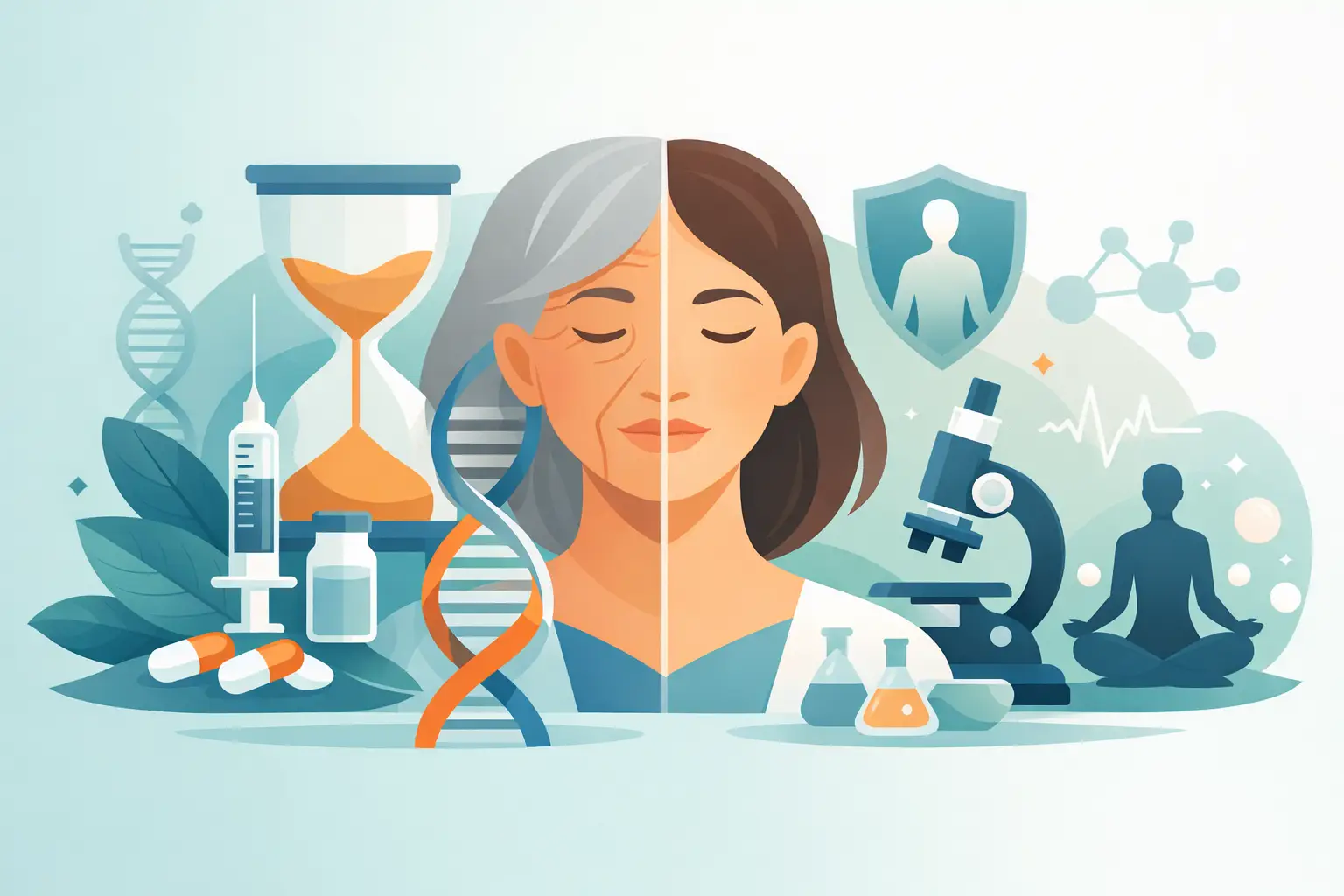
Top Therapies for Biological Ageing
A growing number of patients are no longer asking how to hide age. They are asking how to influence it at the biological level. That shift is why interest in the top therapies for biological ageing has moved far beyond cosmetic medicine and into regenerative, physician-led care.
Biological aging is not just about wrinkles, stiffness, or lower energy. It reflects what is happening inside tissues, blood vessels, immune signaling, cellular repair systems, and inflammatory pathways over time. Two people of the same chronological age can have very different biological profiles, which is why modern age-management increasingly focuses on function, resilience, and recovery rather than appearance alone.
For patients exploring advanced care, the right question is not which therapy sounds the most exciting. It is which therapy matches your biology, goals, and current health status. Some approaches are designed to support repair. Others aim to reduce inflammatory burden, improve nutrient delivery, or stimulate rejuvenation signals that decline with age. The most effective programs are usually personalized rather than one-size-fits-all.
What biological ageing treatment is really trying to change
Biological ageing is shaped by several overlapping processes. Chronic low-grade inflammation, mitochondrial decline, hormonal shifts, stem cell exhaustion, slower tissue repair, vascular wear, and immune dysregulation all contribute to how the body ages. That is why no single intervention can fully address age-related decline.
A medically progressive approach looks at the terrain as a whole. Energy, sleep, mobility, cognition, recovery time, skin quality, joint comfort, and metabolic health are all meaningful signals. The goal is not to chase youth in a superficial sense. It is to support the body’s own regenerative capacity so that function is preserved for longer.
Top therapies for biological ageing in regenerative medicine
Stem cell-based therapy
Among the top therapies for biological ageing, stem cell-based treatment attracts the most attention because it is centered on regeneration rather than simple symptom control. In carefully selected patients, mesenchymal stem cells and progenitor-cell approaches are used to support repair, modulate inflammation, and encourage healthier cellular communication.
This matters because aging tissues often become less efficient at healing themselves. Stem cell-based therapies are being explored in settings that involve musculoskeletal degeneration, inflammatory burden, reduced vitality, and broader age-management strategies. The appeal is straightforward – these therapies are designed to work with the body’s own repair mechanisms rather than override them.
That said, expectations should remain grounded. Stem cell therapy is not a shortcut to reversing age across every organ system, and outcomes depend on the patient’s condition, the protocol used, and the quality of medical oversight. The strongest results are usually seen when cellular therapy is part of a broader plan rather than treated as a standalone fix.
Platelet-rich plasma and biologic stimulation
PRP has become well known in sports medicine and aesthetics, but its role in age-management is broader than many patients realize. By concentrating a patient’s own platelets and growth factors, PRP can be used to stimulate local repair responses in tissues that have become slower to recover with age.
This makes it especially relevant for concerns such as skin quality, scalp rejuvenation, joint support, and certain soft-tissue issues. PRP is less dramatic than stem cell-based interventions, but it is often attractive because it is autologous, minimally invasive, and relatively straightforward when performed in an appropriate medical setting.
Its limitation is also clear. PRP works best where stimulation of local healing is the goal. It is not designed to provide the same scope of regenerative signaling as more advanced cellular therapies, particularly in patients with more pronounced degeneration or complex systemic aging concerns.
Bone marrow concentrate therapy
Bone marrow concentrate, or BMC, is another biologic therapy used in regenerative medicine to deliver a rich mix of cells and signaling factors drawn from the patient’s own marrow. For patients dealing with age-related orthopedic decline, persistent pain, or reduced physical resilience, BMC may offer a more intensive regenerative option than PRP alone.
The value of BMC in biological aging lies in its ability to support tissue environments that have become less responsive over time. As joints, tendons, and structural tissues age, they often show both wear and a weaker healing response. BMC is used with the goal of improving that repair potential.
Like all biologic procedures, it is best viewed through the lens of suitability. It may be particularly relevant for active adults or older patients seeking to preserve mobility and delay more invasive interventions, but it is not the right fit for every concern related to aging.
IV infusion therapies for cellular support
Not every age-management therapy needs to involve cell harvesting or injection-based procedures. Medically supervised IV infusions remain a valuable part of many advanced longevity programs because they can address nutrient deficits, oxidative stress, dehydration, and recovery burden with greater precision than oral supplementation alone.
Depending on the formulation, infusion therapy may support mitochondrial function, immune balance, detoxification pathways, and post-exertion recovery. For some patients, this translates into better energy, sharper cognition, and improved resilience during times of physical stress.
The trade-off is that infusions are usually supportive rather than transformative on their own. They can improve the terrain in which regeneration happens, but they do not replace deeper interventions when a patient has significant degenerative or inflammatory issues. Used strategically, however, they can complement more advanced therapies and improve readiness for treatment.
Peptide and signaling-based therapies
Peptide therapy has gained momentum in age-management because it aims to influence repair, recovery, metabolic function, and tissue signaling with a more targeted approach. Certain peptides are used in clinical settings to support sleep quality, body composition, healing response, or cellular maintenance.
For patients interested in biologic optimization, peptides are appealing because they sit somewhere between pharmaceutical precision and regenerative philosophy. They are not the same as stem cell treatment, but they may help amplify recovery pathways that decline with age.
This is an area where medical supervision matters enormously. Peptide protocols vary widely, and not every product marketed for longevity is credible or appropriate. The best use of peptides is selective, personalized, and integrated into a physician-guided plan rather than pursued as a trend.
Hormonal optimization when clinically appropriate
Hormones are not the whole story of aging, but they remain a major part of it. Changes in testosterone, estrogen, progesterone, thyroid function, DHEA, and related pathways can influence body composition, mood, sleep, sexual wellness, cognition, and vitality.
When a patient’s symptoms and lab findings align, medically supervised hormone optimization may become one of the more effective therapies for improving quality of life. It can help restore a better physiological baseline, particularly in midlife and beyond.
Still, this is one of the clearest examples of an it-depends therapy. Hormone treatment can be helpful, but it requires careful evaluation, proper dosing, and ongoing monitoring. It is not a universal anti-aging answer, and it should never be treated casually.
Why combination programs often outperform single therapies
Patients often arrive hoping to identify one standout treatment, but biological aging rarely behaves that neatly. Someone with fatigue, slower recovery, joint discomfort, poor sleep, and inflammatory stress may need more than one layer of intervention. A cellular therapy might address repair. PRP or BMC might support localized degeneration. Infusions may improve nutrient status and recovery. Hormonal or peptide support may help restore broader physiological balance.
This is why premium regenerative clinics increasingly build treatment pathways instead of isolated procedures. At CellStemClinic, that model aligns with how many patients actually experience aging – not as one problem, but as a gradual decline across multiple systems that need coordinated support.
Who may benefit most from advanced age-management therapies
The best candidates are often adults who feel that standard wellness advice is no longer enough. They may still be functioning well, but they notice clear changes in energy, recovery, mobility, skin quality, sleep, focus, or inflammatory symptoms. Others have already developed chronic or degenerative conditions and want options that are more restorative than conventional symptom management alone.
There is also a group of proactive patients who are not yet significantly impaired but want to invest early in preserving function. For them, treatment is less about rescue and more about extending health span with a medically guided plan.
The key is proper screening. Advanced regenerative treatment should begin with an honest assessment of goals, medical history, severity of decline, and what is realistically modifiable.
What to look for when choosing among the top therapies for biological ageing
A credible provider should be clear about what a therapy is meant to do, what it cannot do, and how it fits into a broader care strategy. Patients should expect individualized recommendations, medical supervision, and a rationale for why one biologic or regenerative approach is being prioritized over another.
The strongest treatment plans do not promise fantasy. They focus on repair, resilience, and measurable improvement where improvement is genuinely possible. That is a more sophisticated and more useful way to think about aging.
The future of age-management will belong to therapies that respect biology rather than fight it. For patients ready to explore advanced care, the most promising path is often the one that restores the body’s capacity to heal, adapt, and keep doing more of what makes life feel fully lived.

